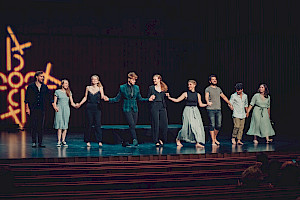
Musiikkitalo, Paavo-sali
ARIA BOREALIS: Semifinaali
ALBINONI - BACH - BATAILLE - CACCINI - CAVALLI - CHARPENTIER - DEMARS - DURÓN - ECCLES - FRESCOBALDI - GRAUPNER - HÄNDEL - JOHNSON - LE CAMUS - LULLY - MAZZOCCHI - MERULA - MONTEVERDI - MONTÉCLAIR - POULENC - PURCELL - RAMEAU - SANCES - SESSA - STROZZI - VIVALDI - WOLKENSTEIN
Toista kertaa järjestettävä kansainvälinen barokkilaulukilpailu Aria Borealis käydään lokakuussa 2026 Helsingissä! Kamarimusiikillisessa semifinaalissa esiintyvät 8 laulajaa pienyhtyeen kanssa.
Klo 18.30–19.30 osa I
Josefine Mindus, sopraano (Ruotsi)
Lucija Ercegovac, mezzosopraano (Kroatia)
Mari Aschehoug, sopraano (Norja)
Klo 20–21 osa II
Lucas Zuehl, bassobaritoni (Yhdysvallat)
Maija Rautasuo, koloratuurisopraano (Suomi)
Virgile Pellerin, kontratenori (Ranska)
Klo 21.20–22 osa III
Martin Höhler, tenori (Saksa)
Antonia Ortner, sopraano (Itävalta)
OHJELMA
Laulajat ovat suunnitelleet itse konserttiohjelman, josta he ovat valinneet tuomareita konsultoiden mieluisan kokonaisuuden Helsingissä esitettäväksi. Laulajat mtös vastaavat harjoitusten liidaamisesta. Tässä esitellään ohjelma laulajien kirjaamassa muodossa:
PART I Josefine, Lucija, Mari
/ JOSEFINE MINDUS
THE RETURN OF PEACE
Folksong. Version inspired by Karin Rehnqvists interpretation.
“I himmelen”
Virgilio Mazzocchi (1597-1646)
“Sdegno, campion audace”
from Cantates italiennes de différents auteurs
Sdegno, campion audace
Della ragion guerriera
Spiegando sua bandiera
Non vuol più tregua, no, non vuol più pace.
Se t'invita lo sdegno,
Alma col suo furore, Rompi quel giogo indegno, Ah, non ha core il core
Hor che sdegno l'avviva,
Viva lo sdegno, viva -
Ch'innalzando la face
Non vuol più tregua, no, non vuol più pace.
(Wrath, the fearless champion
of reason in battle,
raising its banner,
desires no more truce, no more peace.
If wrath should summon you, O soul, in all its fire,
cast off that unworthy yoke; for the heart, once kindled by righteous fury, can remain silent no longer.
Long live wrath, long live it - for lifting high its blazing torch,
it seeks no more truce, no more peace.)
Michel Pignolet de Montéclair (1667-1737)
IV. Récitatif “Ah! Quelle est mon erreur?”
from the Cantata Le Retour de la Paix
Ah! quelle est mon erreur et qu’osais-je entreprendre?
Puis-je espérer de dessiller leurs yeux?
Non, c’est un bienfait que l’on ne doit attendre que de la main des Dieux.
(Ah! what is my error
And what did I dare to undertake? Can I hope to open their eyes?
No, this is a blessing which one may only expect from God himself.)
V. Lent et détaché “Fille du ciel!”
from the Cantata Le Retour de la Paix
Fille du ciel, hâtez-vous, Paix charmante, venez sauver le reste des mortels!
Souffrirez-vous que d’une main sanglante Mars en tous lieux renverse vos autels?
(Daughter of heaven, charming Peace Hasten to save the rest of us mortals!
Will you allow Mars with bloody Mars hands to overturn your altars everywhere?)
VI. Léger et doux “Mais quel éclat soudain!”
Mais quel éclat soudain!
Que de traits de lumière
de ce triste séjour écartent les horreurs!
Les Dieux touchés de nos malheurs, auraient-ils exaucé mon ardente prière?
(But what sudden radiance!
What shafts of light
drive away the horrors of this mournful place!
Have the gods, moved by our suffering, at last answered my fervent prayer?)
Tomaso Albinoni (1671-1751)
“Si rinforzi in te la spene” from Andromeda liberata
Si rinforzi in te la spene Di quel bene
Che felice ti può far.
Col piacere che mi fingo Mi lusingo
Di dar fine al tuo penar.
(May hope grow strong within you Of that blessing
That can make you happy.
With the pleasure I imagine,
I flatter myself
That I may put an end to your suffering.)
Francis Poulenc (1899-1963)
“Priez pour paix”
Text by Charles d'Orléans
Priez pour paix, douce Vierge Marie,
Reine des cieux, et du monde maîtresse,
Faites prier, par votre courtoisie,
Saints et saintes, et prenez votre adresse
Vers votre Fils, requérant sa haultesse
Qu'il lui plaise son peuple regarder,
Que de son sang a voulu racheter,
En déboutant guerre qui tout dévoie;
De prières ne vous veuillez lasser:
Priez pour paix, le vrai trésor de joie.
(Pray for peace, sweet Virgin Mary,
Queen of heaven and Mistress of this world,
Cause, by your courtesy, all the saints
Of either gender to pray, and address
Your Son, beseeching his high Majesty
To deign to look upon his people,
Whom he willingly redeemed with his blood,
Banishing war which ruins everything; Pray untiringly, we beg of you:
Pray for peace, the true treasure of joy!)
Folksong. Version inspired by Karin Rehnqvists interpretation.
“I himmelen”
I himmelen, i himmelen där Herren Gud själv bor,
hur härlig bliver sällheten, hur outsägligt stor!
Där ansikte mot ansikte jag evigt, evigt Gud får se, se Herren Sebaot.
(In heaven, in heaven,
where the Lord God Himself dwells, how glorious shall blessedness become, how unspeakably great!
There, face to face,
I shall behold God forever,
forever the Lord of Hosts.)
/ LUCIJA ERCEGOVAC
Tarquinio Merula (1595-1665)
„Hor ch‘è tempo di dormire“ (Canzonetta spirituale sopra alla nanna), published 1638.
in Curtio precipitato et altri capricii, collection of songs for voice and basso continuo by Tarquinio Merula
Hor ch'è tempo di dormire
Dormi dormi figlio e non vagire
Perchè tempo ancor verrà
Che vagir bisognerà
Deh ben mio deh cor mio fa
Fa la ninna ninna na
Amor mio sia questo petto
Hor per te morbido letto
Pria che rendi ad alta voce
L'alma al Padre su la croce
Queste mani e questi piedi
Che con gusto e gaudio vedi
Ahimè com'in vari modi
Passeran acuti chiodi
Dormi dunque figlio mio
Dormi pur redentor mio
Perchè poi con lieto viso
Ci vedrem in paradiso
Hor che dorme la mia vita
Del mio cor gioia compita
Tacciaognun con puro zelo
Taccian sin la terra e'l cielo
E fra tanto io che farò
Il mio ben contemplerò
Ne starò col capo chino
Sin che dorme il mio bambino
Francesco Cavalli (1602-1676)
„Vieni, vieni in questo seno“, aria of Nerea from the III. Act of the operaLa Rosinda (1651)
Vieni, vieni in questo seno,
Che sereno già t'accolse entro il suo latte.
Le sue, caro, mamme intatte,
Se già manna a te stillaro,
Da quei fini lor rubini,
Vo' ch'ambrosia or ti zampillino.
Si tranquillino, mio placato,
e bel Polluce,
Le mie sorti alla tua luce.
Girolamo Frescobaldi (1583-1643)
„Se l‘aura spira tutta vezzosa“, F 7.15, published 1630. in collectionPrimo libro d’arie musicali per cantarsi
Se l'aura spira tutta vezzosa,
la fresca rosa ridente sta,
la siepe ombrosa di bei smeraldi
d'estivi caldi timor non ha.
A balli, a balli, liete venite,
ninfe gradite, fior di beltà.
Or, che sì chiaro il vago fonte
dall'alto monte al mar sen' va.
Suoi dolci versi spiega l'augello,
e l'arboscello fiorito sta.
Un volto bello al l'ombra accanto
sol si dia vanto d'haver pieta.
Al canto, al canto, ninfe ridenti,
Scacciate i venti di crudelta.
Jean-Baptiste Lully (1632-1687)
„Espoir si cher et si doux“, aria of Cybèle from the III. Act of the operaAtys, LWV 53 (1676)
Espoir si cher, et si doux,
Ah! Pourquoy me trompez-vous?
Des suprêmes grandeurs vous m'avez fait descendre, mille coeurs m'adoroient, je les neglige tous, je n'en demande qu'un, il a peine à se rendre.
Je ne sens que chagrins, et que soupçons jaloux, est-ce le sort charmant que je devois attendre?
Espoir si cher, et si doux,
Ah! Pourquoy me trompez-vous?
Helas! Par tant d' attraits falloit-il me surprendre? Heureuse, si toûjours j'avois pû m'en deffendre
L'amour qui me flattoit me cachoit son couroux, c'est donc pour me fraper des plus funestes coups, que le cruel amour m'a fait un coeur si tendre?
Espoir si cher, et si doux!
Ah! Pourquoy me trompez-vous?
Henry Purcell (1659-1695)
„Ah Belinda, I am prest with torment“, aria of Dido from the I. Act of the opera Dido and Aeneas, Z. 626 (1689)
Ah! Belinda,
I am pressed with torment not to be confessed.
Peace and I are strangers grown.
I languish till my grief is known
Yet would not have it guessed.
/ MARI ASCHEHOUG
AMORES DIVINI
Where Gods and Mortals meet
Claudio Monteverdi (1567-1643)
Laudate Dominum, SV 287
Laudate Dominum in sanctis eius
Laudate eum in firmamento virtutis eius,
Laudate eum in sono tubae,
Laudate eum in psalterio et cithara.
Laudate eum in tympano et choro;
Laudate eum cimbalis benesonantibus iubilationibus
Omnis Spiritus laudat Dominum!
Alleluia
Johann Sebastian Bach (1685-1750)
Ich ende behende mein irdisches Leben
(from Selig ist der Mann, BWV 57)
Ich ende behende mein irdisches Leben,
Mit Freuden zu scheiden verlang’ ich jetzt eben.
Mein Heiland, ich sterbe mit höchster Begier,
Hier hast du die Seele, was schenkest du mir?
Georg Friedrich Händel (1685-1759)
O sleep, why dost thou leave me?
(from Semele, HWV 58)
Oh sleep, why dost thou leave me?
Why thy visionary joys remove?
Oh sleep,
again deceive me,
To my arms
Restore my wand'ring love.
Hélène-Louise Demars (1736-1778)
Alcide subjugué laisse ravir ses armes..
Beautez, de vos amans ménagez mieux la gloire
(from cantata Hercule et Omphale)
Alcide subjugué laisse ravir ses armes,
elles sont pour son bras, un trop pedant fardeau,
Sa fierté l’abandonne, il ne trouve des charmes,
qu’à filer près d’Omphale et tourner un fuseau.
Beautez, de vos amans ménagez mieux la gloire,
vos plaisis en seront plus doux.
En partageant leur triomphe avec vous,
ils augmentent votre victoire.
Antonio Vivaldi (1678-1741)
Alleluia
(from cantata In furore iustissimae irae, RV.62)
Alleluia
PART II Lucas, Maija, Virgile
/ LUCAS ZUEHL
A NIGHT OF CRIES
What the voice does in darkness
Christoph Graupner (1683-1760)
Herr, die Wasserströme erheben sich GWV 1115/34: No. 3 Aria (composed 1734)
"Ach, wie lange soll der kleinen Heerden bange"
Ach, wie lange
soll der kleinen Heerde bange
und sie so verlassen sein?
Jesus schläft,
da Fromme zagen,
seine Sonne will nicht tagen,
und des Glaubens Light ist klein.
Oswald von Wolkenstein (1377-1455)
Geistliche und weltliche Lieder No. 93
"Fröleich geshrai"
Fröleich geschrai
So well wir machen, lachen, swachen den zwar, der uns nicht gevelt
Junkfrau, sind die air noch gar gezelt?
So lauft, ir zieren held, und esst si ungeschelt!
Frau gelt! Trag her des weines kelt!
„So schön“, sprach des maiers diern, „all niden auff der pank.“
Mach lank, geselle mein, hab immer dank!
Dein gesank, und getrank und süsser winkenwank pringt mir freuden vil.
„Smutz“, sprach mein Frau,
„Nu welcher videlt mir neur auff meinem saiten Spiel?“
„Das tuen ich“, Hainzel und Jäggel, da mit hueb sich ain gäggel.
Da sprach si: „Snäggel!“
Awe, Hainz magstu nimmer? So kum, Jäggline!
Trauter socie, ler mich das A, B, C
und tue mit doch nit we! Ite venite.
Robert Johnson (1583-1633)
"Care-charming Sleep"
Care-charming sleep,
thou easer of all woes,
Brother to death,
sweetly thyself dispose
on this afflicted prince
fall like a cloud in gentle show'rs;
give nothing that is loud or
painful to his slumber;
But easy, sweet
And as a purling stream,
thou son of night.
Pass by his troubled senses;
sing his pain
like hollow murmuring wind,
or silver rain.
Into thyself gently,
O gently, o gently slide
And kiss him into slumbers
Like a bride.
Giovanni Felice Sances (1600-1679)
Motetti a voce sola: No. 17 (composed 1638)
"Pianto della Madonna"
Stabat Mater dolorosa
iuxta Crucem lacrimosa,
dum pendebat Filius.
Cuius animam gementem,
contristatam et dolentem
per transivit gladius.
O quam tristis et afflicta
fuit illa benedicta,
mater Unigeniti!
Quae maerebat et dolebat,
et tremebat cum videbat
nati poenas incliti.
Quis est homo qui non fleret,
Christi Matrem si videret
in tanto supplicio?
Quis non possit contristari
piam Matrem contemplari
dolentem cum Filio?
Amen
arr. Lucas Zuehl (b. 2001)
"Amazing Grace" (composed 2026)
How sweet the sound,
That saved a wretch like me!
I once was lost,
But now am found;
Was blind, but now I see.
His grace hath taught
My heart to fear,
And grace my fears relieved;
How precious
Did that grace appear
The hour I first believed!
Through many dangers,
Toils and snares,
I have already come;
His grace hath brought
Me safe thus far,
And grace will lead me home.
When we've been there
Ten thousand years,
Bright shining as the sun,
We've no less days
To sing God's praise
Than when we'd first begun.
/ MAIJA RAUTASUO
Jean-Philippe Rameau (1683–1764)
Shepherdness' ariette "Rossignols amoureux"
from the opera Hippolyte et Aricie (1733)
Librettist: Simon-Joseph Pellegrin (1663–1745)
arr. Miikka Lehtoaho
Rossignols amoureux,
Répondez à nos voix
Par la douceur de vos ramages.
Rendez les plus tendres hommages
À la divinité qui règne dans nos bois.
Henry Purcell (1659–1695)
Cupid's aria "The Cares of Lovers"
from the opera Timon of Athens, Z. 632 (1694)
playwrite: Thomas Shadwell (1642–1692), adapting William Shakespeare
The cares of lovers, their alarms,
Their sighs, their tears, have pow'rful charms:
And if so sweet their torment is,
Ye gods! how ravishing the bliss!
So soft, so gentle is their pain,
Tis ev'n a pleasure to complain.
Johan Sebastian Bach (1685–1750)
Soprano aria "Ich folge dir gleichfalls"
from Johannes Passion BWV 245 (1724)
Ich folge dir gleichfalls mit freudigen Schritten
Und lasse dich nicht, Mein Leben, mein Licht.
Befördre den Lauf Und höre nicht auf,
Selbst an mir zu ziehen, zu schieben, zu bitten.
Henry Purcell (1659–1695)
Urge me no more, Z. 426 (1682)
Urge me no more, this airy mirth belongs
To better times, these times are not for songs.
The sprightly twang of the melodious lute
Agrees not with my voice, and both unsuit
My untun'd fortunes. Th'affected measure
Of strains that are constrained afford no pleasure.
Music's the child of mirth, where griefs assail
The troubled soul, both voice and fingers fail;
My grief's too great for smiling eyes
To cure or counter charms to exorcise.
The raven's dismal croaks, the midnight howls
Of empty wolves mix'd with the screech of owls,
The nine sad knolls of a dull passing bell,
With the loud language of a nightly knell,
And horrid outcries of revenged crimes,
Join'd in a medley, is music for these times.
These are no times to touch the merry strings
Of Orpheus, no, Ah! no, these are no times to sing.
How can my music relish in your ears,
That cannot speak for sobs nor sing for tears?
/ VIRGILE PELLERIN
CUPID'S LESSON
The many faces of love in seventeenth-century music
Claudio Monteverdi (1567–1643)
“Eccomi trasformato d’Ottone in Drusilla” (Opera: L’incoronazione di Poppea, 1642)
Pushed to his limits, Ottone is about to kill the one he loves, Poppea. This excerpt takes place just before Cupid intervenes to stop him from committing the unthinkable. He has been watching from the beginning, amused to see just how low human beings can sink when driven by power and love.
Excerpt of the text, written by librettist Giovanni Francesco Busenello :
Il cor, fuor del suo sito,
Ramingo per le viscere tremanti
Cerca un cupo recesso per celarsi,
O involto in un singulto,
Ei tenta di scampar for di me stesso,
Per non participar in tanto eccesso.
(The heart, out of its place,
Wandering through the trembling guts,
Seeks a dark corner in which to hide,
Or, wrapped in sobs,
It tries to escape from within myself,
So as not to partake in such excess.)
Henry Purcell (1659–1695)
“Cupid, the slyest rogue alive”, Z.367 (Published in The Theater of music, 1685)
But Cupid has many faces. He is also suddenly a mischievous young child, who steals honey from the bees. Stung by one of them, he runs to his mother, who gently makes fun of him: he may be very small himself, but his sting, like that of a bee, can be terribly painful.
Cupid, the slyest rogue alive,
One day was plundering a hive:
A bee surprised the heedless boy
Pricked him and dashed the expected joy!
Sébastien Le Camus (ca. 1610–ca. 1677)
“Amour, cruel Amour, laisse finir mes larmes” (Air de cour published in Airs à deux et trois parties, 1678)
A disappointed lover confronts Cupid and demands an explanation:
Amour, cruel Amour, laisse finir mes larmes.
Je ne saurais suffire à tant d'ennuis secrets.
Tes sensibles douleurs n'ont pour moi plus de charmes,
Faut-il pour un ingrat de si tendres regrets,
Amour, cruel Amour, laisse finir mes larmes.
D'un si volage amant les perfides désirs
M'ont déjà trop coûté de pleurs et de soupirs.
De mortelles langueurs, et de tristes alarmes.
Hélas ! Pour un ingrat qui ne sait point aimer.
Faut-il dans la douleur se perdre et s'abîmer ?
Amour, cruel Amour, laisse finir mes larmes.
Anonymous,
“Vuestros ojos tienen d'amor no sé qué” (Chanson espagnole published in Second livre d'airs de différents auteurs mis en tablature de luth, 1609, arranged by Gabriel Bataille, 1576–1630)
This Spanish song travelled widely across Europe at the beginning of the seventeenth century and found its way into the music of French and English composers such as Bataille and Dowland.
Vuestros ojos tienen d’amor no sé qué,
Que me hielan, me roban, me hieren, me matan a fé.
¿Por qué me miráis con tanta aflicción,
Y a mi corazón me aprisionáis?
¡Que si vos me miráis, yo os acusaré!
(Your eyes hold I-know-not-what of love.
They freeze me, steal me, wound me, kill me, I swear.
Why do you look upon me with such affliction
And in my heart you imprison me?
For if you look at me, I will accuse you!)
Sebastián Durón (1660–1716)
“Sosieguen, descansen” (Zarzuela: Salir el Amor del Mundo, 1696)
In Sebastián Durón’s zarzuela, Cupid enters Diana’s forest and disrupts its sacred order. It is then pursued by the gods, defeated and finally banished from the world. Exhausted, Cupid lies down on a rock and falls asleep.
Excerpt of the text, written by librettist José de Cañizares :
Sosieguen, sosieguen,
Descansen, descansen
Las tímidas penas,
Los tristes afanes,
Y sirvan los males
De alivio en los males.
(Let them be soothed,
Let them rest,
The timid sorrows,
The sad cares,
And let the sufferings serve
As relief in the sufferings.)
PART III Martin, Antonia
/ MARTIN HÖHLER
Marc-Antoine Charpentier 1643–1704
Recit. “Tristes déserts, sombre retraite” H. 469
Tristes déserts, sombre retraite,
Rochers, à qui, toujours, j’ai confié mon sort;
Écoutez le récit de la douleur secrète,
Qui me fait courir à la mort :
J’aimais, j’étais aimé;
Du bonheur de ma vie,
Les rois les dieux étaient jaloux.
Hélas! ce temps n’est plus,
L’infidèle Sylvie de mon rival fait son époux.
Tristes déserts, sombre retraite,
Rochers, à qui, toujours, j’ai confié mon sort;
Je vous ais dit l’excès de ma douleur secrète
Vous serez témoins de ma mort.
Francesca Caccini 1587–1640
Maria dolce, Maria
(from “Il Primo Libro delle Musiche“)
Maria dolce Maria, come soave tanto
Ch'e pronunciar t'in paradisi core
Nome sacrato e Santo
Ch'el cor m'infiammi di celeste amore
Maria mai sempr'io canto
Ne puo la lingua mia piu felice parola
Trarmi dal sen gia mai che dir
Che dir Maria
Nome ch'ogni dolor tempra'e consola
Voce tranquilla ch'ogni affano acqueta
Ch'ogni cor fa sereno, ogn'alma lieta
Johann Sebastian Bach 1685–1750
“Erbarme dich“
(from BWV 55 “Ich armer Mensch, ich Sündenknecht“)
Erbarme dich!
Lass die Tränen dich erweichen,
Lass sie dir zu Herzen reichen;
Lass um Jesu Christi willen
Deinen Zorn des Eifers stillen!
Erbarme dich!
Henry Purcell 1659–1695
“’Tis nature’s voice”
(from Z. 328 “Hail, Bright Cecilia”)
'Tis Nature's Voice; thro' all the moving Wood
Of Creatures understood:
The Universal Tongue to none
Of all her num'rous Race unknown.
From her it learnt the mighty Art
To court the Ear or strike the Heart;
At once the Passions to express and move;
We hear, and stright we grieve or hate, rejoice or love;
In unseen Chains it does the Fancy bind;
At once it charms the Sense and capivates the Mind.
Claudio Monteverdi 1567–1643
“Oblivion soave”
(from “L’Incoronazione di Poppea”)
Oblivion soave
I dolci sentimenti
In te, figlia, addormenti.
Posatevi occhi ladri,
Aperti deh che fate,
Se chiusi ancor rubate?
Poppea, rimanti in pace;
Luci care e gradite,
Dormite homai, dormite.
/ ANTONIA ORTNER
THE SALTERIOS VOICE
Claudia Sessa (c.1570 - c.1617), Venezia 1613
Canoro Pianto di Maria Vergine sopra la Faccia di Christo Estinto
" Occhi io vissi di voi"
Mentre voi fosti voi ma spenti poi
Vivo di vostra morte
In felice alimento
Che mi nutre al tormento
E mi manca al gioire
Per far vivace morte al mio martire.
Barbara Strozzi (1619-1677), Venezia 1654
Cuore che reprime alle lingua di manifestare il nome della sua cara, "Cantate, ariete, a una, due e tre voci, Op. 3
Ardo in tacito foco,
Ne pure m'è concesso
Dal geloso cor mio
Far palese a me stesso
Il nome di colei ch'è 'l mio desio,
Ma nel carcer del seno
Racchiuso tien l'ardore,
Carcerier di se stesso il proprio core.
E appena sia contento
Con aliti e sospiri
Far palese alla lingua i suoi martiri.
Se pur per mio ristoro,
Con tributi di pianto,
Mostrar voglio con fede
A quella ch'amo tanto
Che son d'amor le lagrime mercede,
Ecco 'l cor ch'essalando
Di più sospiri il vento,
Assorbe il pianto e quell'umor n'ha spento.
E con mio duol m'addita
Che gl'occhi lagrimanti
Sono mutole lingue negli amanti.
G. F. Händel (1685-1759)
"Salve Regina" HWV 241
"Ad te clamamus" HWV 241
Salve Regina, Mater misericordiae
Vita dulcedo, et spes nostrae, salve.
Ad te clamamus, exsules filii Hevae.
Ad te suspiramus, gementes et flentes
In hac lacrimarum valle.
Antonia Ortner
"Es pliant"
A hopeful pop song about blossoming for Voice & Salterio in Innervillgraterisch
Jo schau, wie`s pliant, die kerschn und die piarn,
Jo schau, wie`s griant, und öffe die tiarn.
Fro de weare bisch, wosse tuisch,
Wie es moansch, und wosse willsch.
Kansainvälisen vanhan musiikin laulajille tarkoitetun Aria Borealis -laulukilpailun ovat luoneet, kehittäneet ja sitä johtavat Nordic Baroque Scene (NBS) -verkoston neljä yhtyettä: Barokkanerne (Norja), Concerto Copenhagen (Tanska), Drottningholmin barokkiyhtye (Ruotsi) ja Suomalainen barokkiorkesteri (Suomi). Helsingin-toteutuksessa yhteistyötä tehdään myös Floridanten (Viro) kanssa. Tässä laulukilpailussa on kyse ennen kaikkea esittäjien vuorovaikutuksesta ja yhteistyöstä! Tuomariston muodostavat Emma Kirkby, Veerle Declerck, Justin Doyle ja Jadran Duncumb.
Kilpailu on osa 30.9.–4.10.2026 järjestettävää Helsinki Early Music Festivalia. Muina kilpailun järjestäjinä toimivat Musiikkitalo ja Suomalainen barokkiorkesteri. Kilpailun yhteydessä järjestetään myös kaikille avoimia Boreallas-nimellä kulkevia yleisötapahtumia.
Semifinaali I 12-25 €
Semifinaali II & III 23-40 €
Koko semifinaali 60 €
Semifinaali + finaali
LIPPULINKKI
